Home Service Marketing Budget: What You Should Really Be Spending (2026 Guide)
DAte
Category
Marketing
Reading Time
There is no shortage of marketing advice in the home services space.
Every platform promises more calls. Every agency claims better results. And every channel seems like the missing piece.
Yet, many business owners still find themselves asking the same question months later:
“Why isn’t this working the way it should?”
The issue is rarely effort. It is rarely budget.
More often, it comes down to choosing the wrong channel for the wrong goal—or expecting one channel to carry the entire business.
If you are trying to grow consistently, the real objective is not choosing between Google Ads, SEO, or lead platforms.
It is understanding how each one performs, where it fits, and what role it should play in your overall strategy.
The Reality Most Contractors Discover Too Late
At some point, most home service businesses try all three.
They run ads and see quick calls—but costs climb fast.They invest in SEO and get impatient waiting for results.They sign up for lead platforms and realize they are competing for the same customer.
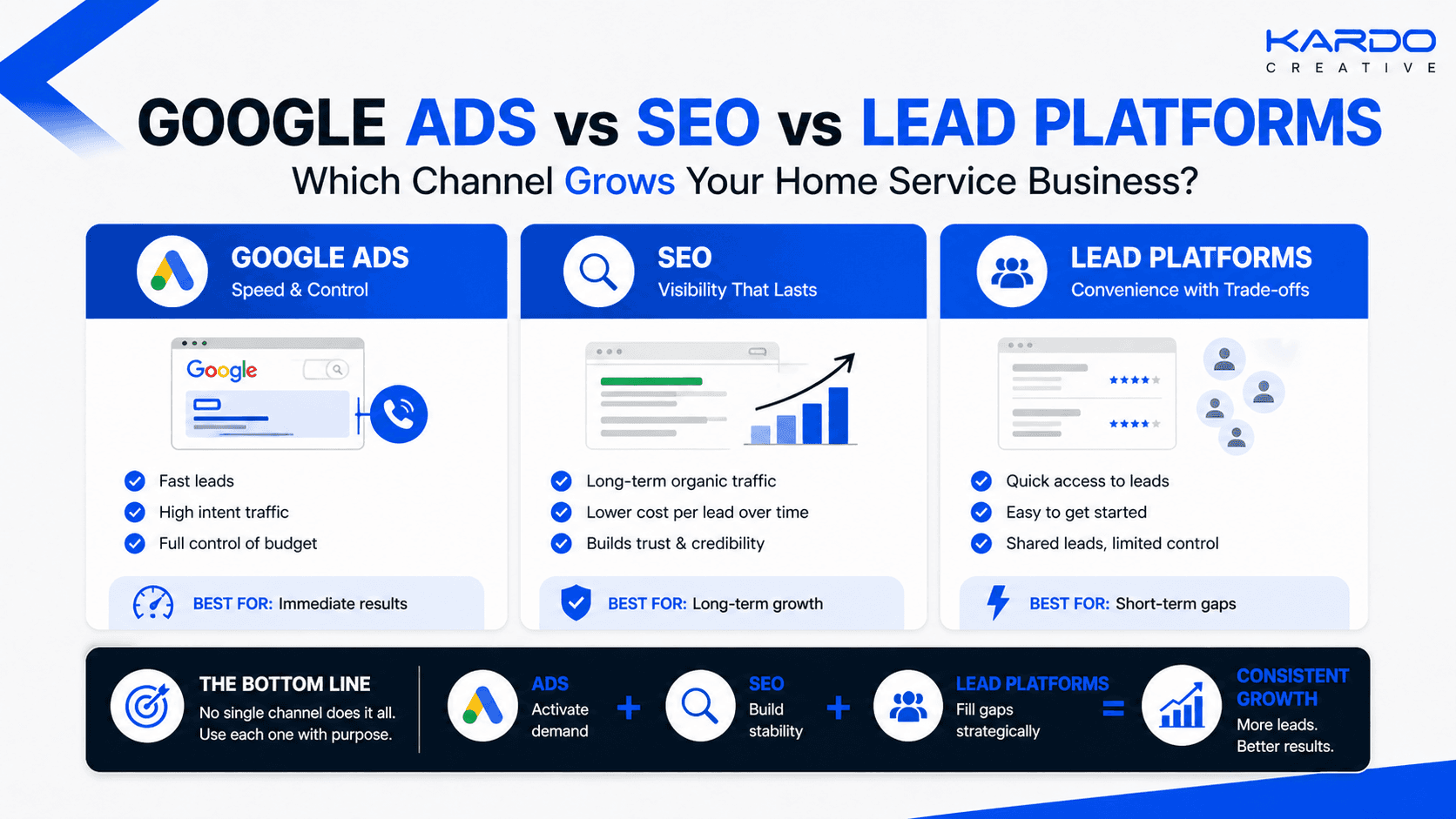
Individually, each channel can produce results.
However, none of them were designed to solve everything on their own.
That is where confusion begins—and where most marketing budgets lose efficiency.
A Clear Breakdown of Each Channel
Instead of guessing, let’s break down how each option actually performs in real-world scenarios.
Google Ads: Speed and Control—At a Price
Google Ads is often the fastest way to generate incoming calls.
When someone searches for a service, your business appears at the top. That visibility can turn into leads almost immediately.
Where Google Ads Performs Best
Captures high-intent searches
Delivers fast lead flow
Allows precise targeting and budget control
You can start seeing calls within days. That makes it powerful, especially for newer businesses or slow seasons.
Where Google Ads Becomes Challenging
Cost per click increases in competitive markets
Campaigns require ongoing adjustments
Results disappear when campaigns pause
This means Google Ads works like a faucet. When it is on, leads flow. When it is off, everything stops.
When It Makes Sense
Google Ads is ideal when:
You need immediate visibility
Your service demand is time-sensitive
Your website is ready to convert traffic
It delivers speed—but not stability on its own.
SEO: Building Visibility That Lasts
Search engine optimization operates differently.
Instead of paying for visibility, you earn it over time by building authority, relevance, and trust.
What SEO Brings to the Table
Consistent organic traffic
Lower cost per lead over time
Strong credibility with customers
When your business appears organically in search results, it carries more trust than paid placements.
Where SEO Requires Patience
Results take time to develop
Requires consistent content and optimization
Needs a solid technical and content foundation
Businesses often abandon SEO too early because they expect immediate returns.
When SEO Becomes Valuable
SEO is most effective when:
You are planning for long-term growth
You want predictable lead flow
You aim to reduce reliance on paid channels
Over time, SEO becomes the backbone of a stable marketing system.
Lead Platforms: Convenience With Trade-Offs
Lead generation platforms offer a different approach.
Instead of building your own marketing system, you purchase access to potential customers.
Why Businesses Use Them
Easy setup
Immediate access to leads
No need to manage campaigns
For businesses looking for a quick entry point, this can feel appealing.
The Hidden Limitations
Multiple competitors receive the same lead
Pricing is controlled by the platform
Brand visibility is limited
In many cases, you are not building your own pipeline—you are renting access to someone else’s.
Where They Fit Best
Lead platforms can help when:
You need to fill schedule gaps
You are testing new service areas
You are not yet ready to run campaigns
However, they are rarely a sustainable growth strategy.
Side-by-Side: What You’re Really Getting
Channel | Lead Speed | Cost Control | Brand Ownership | Scalability |
|---|---|---|---|---|
Google Ads | Immediate | High | High | Medium |
SEO | Gradual | Medium | High | High |
Lead Platforms | Immediate | Low | Low | Low |
This comparison highlights an important point:
Each channel solves a different problem.
The Common Mistake: Expecting One Channel to Do Everything
Many businesses invest heavily in one channel and expect it to handle:
Lead generation
Brand visibility
Long-term growth
No single channel is designed to do all three.
For example:
Ads generate traffic, but do not build lasting visibility
SEO builds authority, but does not deliver instant results
Lead platforms provide access, but not ownership
Without balance, results become unpredictable.
A Smarter Approach: Building a Layered Strategy
Instead of choosing one, high-performing businesses use each channel with purpose.
Step 1: Use Ads to Activate Demand
Google Ads keeps your pipeline active. It ensures you capture immediate opportunities.
Step 2: Use SEO to Build Stability
SEO reduces dependency on paid traffic and strengthens long-term visibility.
Step 3: Use Lead Platforms Strategically
Lead platforms can fill short-term gaps without becoming your primary source of leads.
When these layers work together, your marketing shifts from reactive to structured.
Where Strategy Turns Into Results
Even with the right mix of channels, results depend on execution.
The difference between average and high-performing campaigns comes down to alignment.
What Needs to Work Together
Targeting that matches your ideal customer
Messaging that clearly communicates value
A website designed to convert visitors into inquiries
Without this alignment, traffic alone will not deliver results.
How Kardo Creative Approaches Marketing Systems
At Kardo Creative, the focus is not on individual tactics.
It is on how every piece connects.
As a home services marketing agency, the process is built around:
Understanding your business and market
Structuring campaigns around real demand
Continuously improving performance through data
Instead of chasing leads, the goal is to build a system that produces them consistently.
How to Choose the Right Strategy for Your Business
If you are unsure where to start, use this quick guide:
Need leads now? Start with Google Ads
Want long-term growth? Invest in SEO
Need quick jobs? Use lead platforms carefully
Then build toward a balanced system.
FAQs About Google Ads, SEO, and Lead Platforms
Which is better: Google Ads or SEO?
Both serve different purposes. Ads generate immediate leads, while SEO builds long-term growth.
Are lead generation sites worth it?
They can help short-term, but relying on them limits control and scalability.
How long does SEO take to work?
Most businesses see meaningful results within 3 to 6 months.
Why are my Google Ads expensive?
High competition and poor targeting often increase costs.
Can I rely on just one marketing channel?
No. Sustainable growth requires a combination of strategies.
The Bottom Line: Stop Choosing—Start Building
There is no single “best” channel.
There is only the right combination.
When your marketing is built as a system, everything changes:
Leads become consistent
Costs become predictable
Growth becomes scalable
That is how real marketing works.
Ready to Build a Marketing System That Actually Works?
If you are tired of guessing which channel to use, it is time to build a strategy that connects everything.
Kardo Creative helps home service businesses turn scattered efforts into a structured growth system.
Schedule your free consultation todayand find out which channels will drive real results for your business.Let’s build a marketing system that brings you consistent, high-quality leads.